

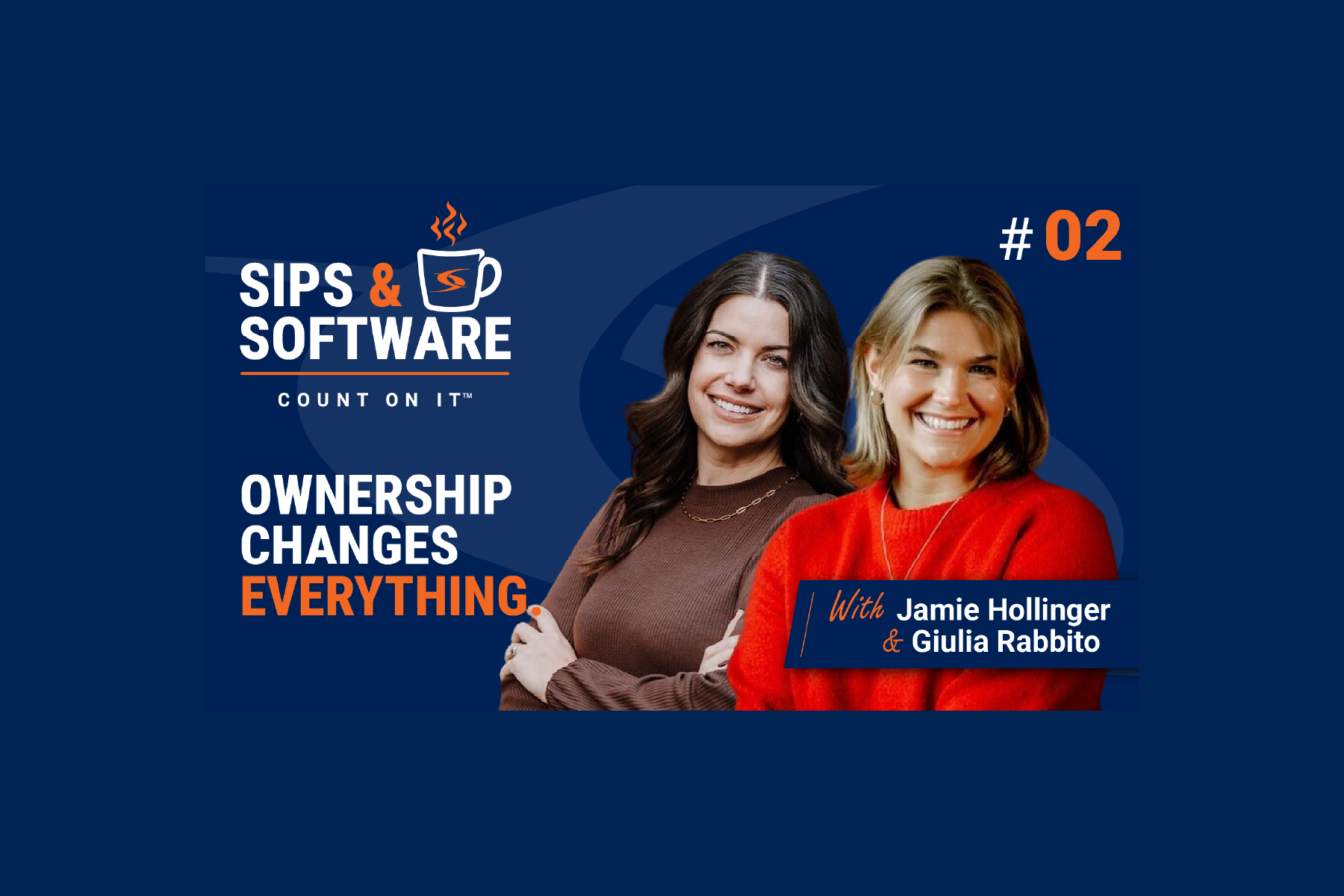
What Happens When Employees Become Owners?
Ownership Changes Everything.
Employee Ownership Is More Than a Business Structure
Employee ownership is often discussed as a business model, but its impact reaches far beyond company structure. It influences culture, decision making, customer relationships, and the way organizations plan for the future.
In the second episode of Sips & Software, host Jamie Hollinger is joined by Giulia Rabbito, Account Executive at Karmak, to explore what employee ownership really means and why it continues to gain attention across industries.
As a 100% employee owned company, Karmak believes ownership creates more than financial investment. It encourages accountability, collaboration, and a long-term mindset that benefits employees, customers, and the organization as a whole. Throughout the conversation, Jamie and Giulia discuss what an Employee Stock Ownership Plan (ESOP) is, how it works, and why employee ownership can be a powerful model for businesses looking to preserve their culture while planning for the future.
What You'll Learn in This Episode
- What an Employee Stock Ownership Plan (ESOP) is
- How employee ownership differs from traditional ownership models
- Why employee ownership creates a culture of accountability
- How ESOPs can support succession planning for privately held businesses
- Why employee ownership benefits both employees and customers
Understanding Employee Ownership
Employee ownership is often misunderstood, but at its core, it's about giving employees a meaningful stake in the long-term success of the company.
Jamie and Giulia explain how an ESOP allows employees to build ownership over time while contributing to the organization's growth. Rather than focusing solely on short-term performance, employee ownership encourages people to think about the long-term health of the business and the role they play in its continued success.
For many organizations, that ownership mindset becomes part of the company culture, influencing everything from collaboration and innovation to customer relationships.
Ownership Changes the Way People Work
One of the biggest themes throughout the conversation is that ownership changes perspective.
When employees understand they're contributing to something they collectively own, decisions often become more thoughtful and more collaborative. Teams look for ways to improve processes, support one another, and create lasting value because everyone benefits when the organization succeeds.
Employee ownership doesn't replace strong leadership or company values. Instead, it reinforces them by encouraging every employee to think beyond today's challenges and consider the long-term impact of their work.
Why Employee Ownership Matters to Customers
While employee ownership has clear benefits for employees, customers also experience the difference.
Organizations built around ownership often focus on long-term relationships rather than short-term transactions. Employees are invested in delivering quality work, solving problems, and helping customers succeed because the company's success is directly connected to their own.
Throughout the episode, Jamie and Giulia discuss how this ownership mentality naturally aligns with customer service, accountability, and partnership.
A Different Approach to the Future
Many businesses eventually face important questions about succession planning and long-term independence.
Employee ownership offers one path for organizations that want to preserve their culture while creating opportunities for future generations of employees. Rather than changing the identity of the business, an ESOP allows companies to continue building on the relationships, values, and reputation they've established over time.
For Karmak, becoming employee owned reinforced a long-standing commitment to customers while ensuring the company remains focused on sustainable, long-term success.
Key Takeaways
- Employee ownership gives employees a meaningful stake in the future of the company.
- ESOPs encourage accountability, collaboration, and long-term thinking.
- Ownership creates a culture where employees are invested in helping both the business and its customers succeed.
- Employee ownership can provide an effective succession planning strategy for many privately held businesses.
- Strong company culture and long-term customer relationships often go hand in hand.
Explore the Podcast
Browse every episode of Sips & Software and discover conversations exploring leadership, technology, customer success, and the commercial transportation industry.

Frequently Asked Questions
What is an Employee Stock Ownership Plan (ESOP)?
An Employee Stock Ownership Plan (ESOP) is a retirement benefit that gives employees an ownership interest in the company, allowing them to share in its long-term success.
How does employee ownership benefit customers?
Employee ownership encourages long-term thinking, accountability, collaboration, and a customer-first mindset, helping organizations build stronger relationships and deliver consistent service.
Why do companies choose employee ownership?
Many organizations adopt employee ownership to preserve company culture, invest in employees, support long-term stability, and create shared success across the business.
What does employee ownership mean at Karmak?
Karmak became 100% employee owned in 2022, giving employee owners a direct stake in the company's long-term success and reinforcing a culture focused on customers, collaboration, and continuous improvement.
Where can I listen to more Sips & Software episodes?
Additional episodes are available on the Karmak website, YouTube, Spotify, Apple Podcasts, and Amazon Music.
Episode Transcript
Jamie Hollinger (00:00.078)
Welcome to the second episode of the Sips and Software Podcast, powered by Karmak and the heavy-duty trucking industry with me, Jamie, as your host. When people think about this industry, they usually think about trucks, parts, service departments, technicians. But if you've spent any time in this industry, you know it's really all about the people. It is about building relationships, taking care of your customers, taking care of your employees, and creating businesses that hopefully last for generations.
In fact, many of our company, the companies that we work with, are family-owned. At Karmak, we have a different type of ownership model, but the philosophy is surprisingly very similar. we are considered an ESOP company and we are proud owners of our own company, which we became 100% employee-owned in 2022. And that happened whenever Richard Shien retired. He was our founder and sold the company to us, the employees. So today we're talking about something a little different, ownership.
My guest, Giulia, I'm so excited to bring her on, has one of the coolest, most fun hiring stories I think I've ever heard. she didn't find Karmak through a job board or a recruiter. She actually met some of our leadership team members at an ESOP conference, and that's how she got introduced to Karmak. But I will let her tell you guys the rest. So we will talk with her about her journey, her passion for esops, what they actually are, and how it may benefit your company to consider it or for you to just learn it.
So whether you're on the road, at your office, working in the shop, or supporting customers behind the scenes, grab your favorite drink and let's get going.
Jamie Hollinger (01:53.846)
Okay, so Giulia, first of all, welcome. I'm so happy that you've joined me today.
Giulia Rabbito (01:59.488)
Yes, me too. Thank you so much for having me. I'm very excited.
Jamie Hollinger (02:02.188)
Yeah. So I think that you might have one of the most unique and fun hiring stories here at Karmak. I just love it. however before we get into that and our topic of ESOP today and employee ownership, I ask my guests two questions. So I want to know what's in your cup. What's in your cup? So since the name is sips and Software, make it casual. I want to know what you're drinking and because you for me, I love a good fun drink, and also what fills your cup. So from a
emotional, spiritual, like when you're when you're about to when your cup has run dry, like what do you do to fill it back up? You know, what what do you do for Giulia? So first and foremost, what are you drinking?
Giulia Rabbito (02:43.718)
Yeah, so in my cup, I've got a a little coffee cup here. In my cup, I have the Summerberry Waterloo. I'm not sure if you guys like seltzer water, but that is what is in my cup. always like to have one of those in the afternoon to just sip on. And then for
Jamie Hollinger (02:59.17)
What is it? What does it say? The cut the front.
Giulia Rabbito (03:02.062)
Well, it just says rise and shine, you know. I just like to wake up and shine every day and just just try. But but but yeah, so that's what's in my cup and on it. And then what fills my cup, great question. I'm gonna do one that I'll do two, one that's relevant of today that I'm really excited about, and then one that is kind of a constant thing. But I have the Noah Con concert today, so I love live music, concerts, everything like that. I think that they're super fun.
and so I'm really excited about that tonight. And then what else? and then just like being outside, being active outside. I love playing pickleball, soccer, running, you know, going for walks, swimming in the lake, all of those things. if I can do at least an hour of that every day, it usually, you know, re energizes me. So
Jamie Hollinger (03:49.014)
Well that is great. I wish I had time for an hour of that a day. I just I love it.
Giulia Rabbito (03:58.536)
it is so fun. Yeah. The the high rise that I live in has like a pickleball court, so it's really easy to just go out there and, you know, play every day.
Jamie Hollinger (04:07.022)
And I I love tennis. and it's it's like tennis, but ping pong, I don't It's picking Melokon too. Woo, he's he's wonderful. I wanna save my money and go. Yeah, well, good stuff. So okay, so now you I need you to tell our entire audience how in the world you ended up meeting the Karmak team at the ESOP conference that you went to and how your persistent
Giulia Rabbito (04:11.928)
Yes. Yeah, it's a yeah.
Giulia Rabbito (04:21.176)
Yes, exactly.
Jamie Hollinger (04:36.056)
selling nature paid off and ultimately brought you here. So
Giulia Rabbito (04:40.51)
Yeah, of course. So yeah, it is a very funny story. and I did not expect it to happen that way. So I'm really glad that it did. But basically, so the last company that I worked for was an ESOP and when you're a part of an ESOP, there's a lot of like, you know, events, webinars, conferences, things like that that are just hosted by the ESOP Association or, you know, the N CEO. And so I, you know, was fortunate enough to go to this event. and it was a a full day event over in the one of the suburbs of Illinois and
I just happened to sit next to the CEO of Karmak, Jim Allen, and the CEFO of Karmak, Chad Storp. And basically we just sort of were talking a little bit and then they started going through ESOP of the Year. And Karmak was nominated, which that's great. But we did come runner up. and so we we came in second place and or not they came in second place at the time because I was not a part of Karmak, but yeah, they came in second place and I sort of like kind of made a joke and
was just like, maybe next year you guys will get them, having no idea that I'd work here next year. But but yeah, so I sort of just made a joke and they were, they were like, Yeah, yeah, well, maybe we'll get them next year. And I just sort of started talking to them and I worked for a technology consulting firm that could partner with Karmak in a couple of ways. So I just sort of, you know, started introducing what my company could do, maybe selling them a little bit, seeing, you know, if there were any synergies and
Jim and Chad were nice enough to s sort of be like, Yeah, like if you, you know, wanted to talk to a couple of the people, these would be the people that would be good. And so I cold called a couple of people at Karmak. I I set a couple of meetings and then those meetings turned into interviews and that interview turned into a job offer. And so, you know, somewhere along the way they they liked what I did, I guess, and and kind of wanted to bring me on the team here. So I'm so grateful for that. And it meant a lot kind of just being appreciated for for something and then then
wanting me to come do it for them. So yeah, it was awesome.
Jamie Hollinger (06:36.448)
Yeah, that is a that's such the best story. So I am on the other side of it and being on the sales team and we were in a meeting and trying to you know, we had a a spot that opened up and the a couple of them were like, What about the Giulia girl? Like she had so much energy and she was smart as attacked and just super positive. So I was like, Yeah, let's try to get an interview with her. You know, so it is funny to hear you try to sell them and then we ultimately sold you on the company.
Giulia Rabbito (07:02.23)
Yeah, right. It was like Mash Me in Heaven, you know, game respects game. yeah, no, it was awesome.
Jamie Hollinger (07:10.658)
Okay. Well we're we're happy to have you. So so back to the conference. So it was up it was up north by where you live. so tell me a little bit about like the Esop community and like what it and maybe tell our listeners too like what an eSop company is because they might have no idea what it is.
Giulia Rabbito (07:29.824)
Yeah, of course. Yeah. So I'll start I'll I'll start by saying what an ESOP is, then I can kind of go into like what the community is like and what those conferences are like. So for any listeners that, you know, don't know what an ESOP is, an ESOP or otherwise known as like an employee stock ownership plan is a retirement benefit that gives employees ownership in the company through stocks. So instead of ownership just only staying at the top level and being with executives and outside investors and things like that.
the actual employees of an eSop earn ownership by helping the company succeed over time. So you know, just for their them showing up every day, they, you know, get stocks in the company and for them doing their job, they make, you know, money off of that. And or they can build a build a a portfolio off of that. So it's a really cool way to build wealth in a in in America and yeah, in a business.
Jamie Hollinger (08:21.772)
Yeah, that's a yeah.
Giulia Rabbito (08:23.122)
Yeah, and then I forgot. And then the kind of what those ESOP conferences are like. basically it's just if you are an ESOP, you're able to go. Also, if you're thinking of becoming an ESOP, you're also able to go to those kinds of events to kind of see what the community is like. But we really talk about all different sorts of things, like, you know, how you can get more involved with the ESOP community. Obviously we did ESOP of the Year and so that kind of runs through all the stats, like how much your company grew, how much your stock grew over the year, how involved you were with, you know.
just certain like esop activities like there's like a bunch of golf tournaments you can host lunch and learns at your ESOP for other esops to come to. So there's just like a whole bunch of things that they talk about. also getting involved like politically with esops. It's it we we just did that here at Karmak. We had I think Senator Steve McClure come. So all those things are are talked about at these events. And then also you can learn about well the a lot of these ESOP events have like speakers. So like someone will speak about
how to become an ESOP, the legal and financial process of that. if you're, you know, acquiring another company as an ESOP, that happens a lot and it goes walks through those processes. So kind of just like the the main common questions that people who are ESOPs or want to become esops ask, they do a lot of like sessions on that.
Jamie Hollinger (09:40.95)
Okay. Yeah. So and goodness gracious. So in order for us to get first place next year, because I'm very competitive. I don't no one wants to be the runner up, you know. what would you say? Like, so get more involved. I mean, not that we already are super involved, but get more involved in the senator come talk. Like what recommendation would you give now that you're here too? Like, how do we get first?
Giulia Rabbito (10:03.7)
Yeah, well, I mean, I we're definitely doing all of the right things for for that position because I feel like the two biggest things are one, growing as an ASOP, like you know, having your stock value move up or you know, expanding your your company, maybe even acquiring a company, something like that could be a really good thing for your your ESOP portfolio. And then and the other side of it is just getting involved, like I said. And so since that conference, Karmak just hosted a senator here. We had that great discussion.
I think they're planning on doing a volunteering event within the community to do that. So all of those things, like just being a successful company and then also, you know, being a successful member and and doing things for the ESOPcommunity are are what you have to do to win first. And it's looking pretty good from here. I don't know who's watching this podcast, but if you're part of the ESOP committee, maybe should keep your eyes on Karmak. So yeah, it's gonna be good.
Jamie Hollinger (10:57.23)
vote for us. We do have a it's interesting, we have a Slack channel at Karmak, because we use Slack internally. and there's just been a lot of activity, a lot of positivity and, you know, a lot of just educating our employees on what it is and definitely a positive thing, you know, that we have going on. So so from a from a private equity standpoint, so private equity has been a
Giulia Rabbito (10:59.24)
Yeah, right.
Jamie Hollinger (11:24.418)
big topic across lots of industries, right? Including heavy duty trucking. So how would you explain the difference between an ESOP company and a private equity owned company to someone who's never thought of it like that before? And I guess you could even move into the family owned, right? So there's lots of different succession plans like that. So can you kind of compare the three a little bit?
Giulia Rabbito (11:46.434)
Yeah, for sure. So I would say from an so I'll kind of start with like ESOP and private equity and then I can go into the family income like and so like just ESOP versus private equity is usually when someone's thinking about a succession plan, that's when the topic of conversation of like ESOP versus private equity can come up. just because it's kind of two different ways that you can do that. And I would say like they're they're both great in their own ways. and there's nothing, you know.
typically wrong or like necessarily wrong with PE or anything. It it absolutely serves a purpose. And but it's just sort of like the goals of both are different. And so like for PE, for example, I feel like they focus a little bit more on like the short term. And so they're they're more focused on, you know, maximizing enterprise value quicker, maximize or increasing operational efficiency as fast as they can, getting investment returns as quickly as possible because these PE firms buy the companies
And then want to get like 10X and then sell it. So they're always kind of thinking of that like future exit. Whereas an ASOP is more focused on just like the long term. They're focused on long-term sustainability of the company. They're focused on increasing employee engagement. They're focused on, you know, increasing customer retention and just preserving that company culture during the succession plan. Whereas sometimes PE firms, you know, they're more so known as like
you know, if your company gets bought by a PE firm, you sort of have to be like, I wonder what's gonna happen to my position or, you know, what's gonna happen to this. And that's just something that that comes up. Whereas when your company becomes an ESOP, that's not really the questions you're focused on. You're sort of focused on like, wow, where do I fit in the long term picture now? Like am I gonna, you know, wanna move up in the y I don't know, like wanna become a president or something like that. Like it's much more focused on just like keeping the employees that you have that built the culture that you have. And
mi putting them in the in the positions to now grow the company. That's that's really what it is. and then yeah, so for companies that sort of value like independence and like employee retention and not and kind of keeping that culture that they have, I think that Esops is such a good option for them. And then you brought up family owned companies, which is obviously a great, you know, a great thing is they are great like s candidates. They're great candidates for ESOPS. So like
Giulia Rabbito (14:01.026)
A family-owned company that, you know, has been around for generations. They, you know, have their family reputation. They have qual they they care about their quality and they care about their customers. Those companies, a lot of them are perfect candidates for eSops because it kind of brings in the question of succession without having to bring in an investor. It's like having your employees invest in the company, if that makes sense. So like the employees buy it from the CEO rather than a PE firm buying it from the CEO and changing everything. So it's sort of like
That's why it they they get brought up a lot within ESOPs. and they're also great partners with ESOPs. Like if you're a family-owned company, there's a lot of similarities between like the mindset of ESOPs and family owned companies, just with like I said, their reputation, their mindset, like their ownership mindset. When you work for a family-owned company and it's your family's company, you really care about how it does because it obviously impacts your, you know, your kids and you know, the next generations to come and everything like that. So
There's a lot of similarities between family owned and and ESOP and then and they work really well together. So sorry, that was a long tangent, but but but yeah.
Jamie Hollinger (15:08.376)
No, that is the great explanation. That's exactly what I was hoping for. So at Karmak, so in 2003, we actually became twenty five percent ESOP owned. and then our our founder, Richard Sheen, he owned the rest of it. So whenever he went to retire and he retired, and then in twenty twenty two they gave ownership or he gave ownership to the employee. So we became a hundred percent employee owned. Which is wonderful, right? So he could have done he could have sold it off, he could have done anything with it.
And he decided to give the ownership back to the employees. So yeah. I'm just curious, the company you worked for before, did that same kind of concept happen, or how did you guys and were you a hundred percent employee owned, or what's a little history from your previous company?
Giulia Rabbito (15:51.262)
Yeah, it's like sort of it's a very similar story, except my last company is sort of in the middle of it. So they just recently, like how you guys bought twenty-five percent in two thousand three, the company I used to be at, they recently just bought thirty percent. So the employees you know, paid our paid their CEO you know, thirty for thirty percent of the company. And so now the employees own thirty percent and they have like an entire like five to seven year plan basically for the employees to then get that rest of the 70%.
And it typically coincides with when the CEO wanna re wants to retire. So when the CEO wants to retire, he's like, hey, let's say, like when Richard kind of was thinking about retiring, he probably was like, I want to retire in five years. I'm sure that Karmak's sort of made like a five year plan of how they're gonna get that rest that that you know second 75% that they needed to kind of own it fully. So my last community is was very similar. And that's honestly a really common like path to ASOP is like it is really hard for this ESOPs.
Some ESOPs will just pay a hundred percent off the bat or they split it into two. It's kinda either or.
Jamie Hollinger (16:54.956)
Yeah, that makes sense. Interesting. Yeah. So do you think and this is kind of not a silly question, but I think the answer is gonna be yes. but so the better we perform as a company, right? The more value we create, not just for customers, but when you're eSop, you're employees as well. So like I don't contribute any money into our ESOP, none of our employees do.
but the company does, right? And there's a share price and we and at the end we make money from it, which is yeah awesome. So talk a little bit about like or what do you see from an eSOP standpoint? like how ESOP changes the way people think and how employees work differently, not just because they suddenly own the company, but because, you know, they're involved and they're helping build something that they personally will benefit from. So can you talk about a little bit and the benefits?
Giulia Rabbito (17:49.046)
Yeah, so I'll kind of talk about it from two I just to make sure you you sort of asked about like how it helps employees and then how it also helps customers, like a two-pronged
Jamie Hollinger (17:57.462)
Yeah. Yeah. Like it's kind of both. I think ultimately it helps the employees give better customers support and success. Yeah.
Giulia Rabbito (18:05.784)
Yeah. Yeah. So yeah, I'll talk about that. So I'll talk about sort of like employees first. And this is honestly a big reason as to why I'm like so passionate about ESOPs, is just because like, well, for example, so like one of the things I love most is that like Karmak, every single employee at Karmak is an employee owner. It doesn't matter whether you're HR, whether you're accounting, whether you're, you know, in sales, whether you're the president or the CEO of the company, you're all a part of it. And it doesn't matter, you know.
Who you are or what you do, you get a stake. And that's really important. and what it excites it, well, I guess like what excites me most about ESOPs is that like most like employee ownership creates these opportunities for everyday people. Like when we think about building wealth in America, we usually think about, you know, buying a home as an asset or investing in the stock market. But like working for an ESOP creates a whole other path because, like you said, we don't contribute like money to this ESOP fund. Like,
We literally just get money for working for the company and doing our job. We just get an entire like separate bank account that just gets money added into it, you know, every single paycheck, which is just so cool. And that, and I just think that's so amazing. And there's a a really cool stat that I think it's like employee owners have like ninety-two percent higher median household wealth than comparable workers that work for non-esop companies. So when you think about that, that's so impressive. Like,
I just think it's it's so cool and it creates this like i I don't know, e working for an eSop is is sort of or e-sops are just like equitable capitalism. It's like everyone wins. It's like a win-win situation for the the owner of the company, for the employees of the company, for the customers even. So so yeah, I just think that that's I love talking about like the good that esops can have or the good impact ESOP can have on their employees. one cool stat that I'll just say is like Publix, the grocery store in Florida.
if you're a cashier or a bagger at Publix, you are also an employee owner and you can, I'm pretty sure there's like thousands of employees that have, you know, retired from Publix with a seven-figure stock portfolio just from their eSub. And that doesn't, it doesn't matter. Like I said, if you're the CEO or you're a cashier, granted, like your scale of stocks can be a little bit different, but those cashiers are still retiring with like so much money, like life-changing money. So it's just really cool. and I love that. And then
Jamie Hollinger (20:23.95)
Amazing.
Giulia Rabbito (20:25.686)
The other approach or the other, you know, element is just like how it helps customers. And like this is another spot where eSops are become really interesting, is that like customers can feel the difference when they're working with an eSOP. Like when you're working with employee owners, you're working with people who genuinely have skin in the game or like have stock in the company. And it just really shows through like through like you said, customer support, through responsiveness, through
You know, the teamwork and like the partnership that Karmak gives their customers, it's just it's just so apparent. because at the end of the day, when customers succeed and when customers are happy and stay with Karmak, Karmak grows, the company becomes more valuable, and then every employee owner at Karmak benefits and it's just like it's like a really good circle of life. It just kind of it just works. So it's it's really cool.
Jamie Hollinger (21:13.474)
Yeah, I love that. And it what's interesting is even from like I mean, over the years I've heard even employees say, like f trying to find ways to cut costs and not to spend so much on our budget and traveling and saving money because it's like it's our own money that, you know, it's affecting us. So it overall it helps the company, which is wonderful.
Giulia Rabbito (21:32.246)
Yeah, exactly. It's like certain things. It's like you wanna it's like when you and your family are trying to go on a vacation, you're gonna like, you know, save up money and it's the same thing with like a an ESOP. It's like when they, you know, when th I don't know, like they they just think of ways to like save money and like it's kind of in essence like you're all saving money. It's it's yeah, it's
Jamie Hollinger (21:50.976)
Yeah, that's so true. Yeah. Yep. That's it's it's a great a great plan to have. It's a great company to be at. You know, when you're employee owned like that, I think there's benefits just across the board with it. and it goes back to the whole family owned as well. You know, I think that it's it's sort of the same thing, whereas it's they have they have stake in it, it's their company or it's their name or it's their parents who own it, or you know, like it represents them and their their generation that they're trying to
you know, ultimately take to the next level and grow and so it's it's pretty cool.
Giulia Rabbito (22:24.236)
Yeah, exactly. It's it's it's awesome. It creates like a level of accountability that I just don't think I just think that it creates a level of accountability that's hard to manufacture in a company that's not an ESOP because, you know, other than that you're just kinda clocking into your nine to five, clocking out, doing what you have to do, but you don't really care about like the long term success. So
Jamie Hollinger (22:36.429)
Yeah.
Jamie Hollinger (22:44.32)
Yeah. I love it makes me so proud to know that, you know, teams like our support team, our client success team, you know, whoever trainers, whoever's working with our customers, like they have full stake in it. Like they care, they want to help our customers. So do you feel like you've seen that already at Karmak or what are your your thoughts around that?
Giulia Rabbito (23:03.062)
Yeah, a hundred percent. I would say yeah, I would say one of the biggest I know you just kind of brought this up, but like one of the biggest ways that I've seen it is through our support team. Like from what I've seen since joining Karmak, our support team doesn't just treat our customers like, you know, like ticket numbers. they do treat them like partners. And I mean, just some stats of our support team is like for average days to close a case, it's not, you know, two days, it's point six
three nine days. So it's like less than a day. We're answering it within two to three hours. We're getting them back to working. We're, you know, doing everything that we can to to get them up and running as fast as possible because we want them to be happy and to feel heard. And I mean like first contact resolution is like sixty four percent of the time they close a case on first contact. So two and I reach out to our our you know client success team to help me out with something I get it back immediately. And it's like they care about that. They're like, wow, you didn't put me on the back burner you
You know, you heard me and you gave me an answer and you prioritized it over everything else. And I think even like our customer satisfaction score was like a four point nine out of five. We we we care so much and I think our customers really see that and they they want they're not just buying Karmak as a software, they're buying Karmak as a long-term, you know, business partner. Like they are trusting in our software to run their business better than it was running beforehand, and we're a huge part in that, like the people of Karmak are because
we're so involved in it once it's implemented. So it's just really cool to see. And yeah, I'm proud of it too. It's awesome.
Jamie Hollinger (24:33.942)
It's you definitely can see it in those ways for sure. And the data doesn't lie, you know, the data's supports all that and it's it's great. So well, I think it is time to hit the road. but Giulia, thank you so much for joining me today and being my second guest on our new podcast. and sharing with sharing with our audience just the story that got you here and help us all kind of better understand what it means to be an employee owned company.
And the benefits and stuff. So I really appreciate your time. So let's grow together because if we grow together, we win together.
Giulia Rabbito (25:10.932)
Exactly. Exactly. Well yeah, thank you so much for having me. This was great guys. Thanks.
Jamie Hollinger (25:14.412)
Yeah, thank you so much. And for our audience, thank you so much for listening and hopefully you grab your favorite drink for episode three. I will be bringing Michelle Sawyer back in to talk about client success. So thank you so much and cheers.
Giulia Rabbito (25:29.314)
Yes. Bye.
Karmak Solutions
See how Karmak helps commercial vehicle businesses streamline operations and work more efficiently.
Improve Operational ROI
Unify Sales, Service & Parts
Scale with Confidence
Related posts
Get ready to see your
business clearly.
No pressure. No commitment. Just a straightforward way to determine whether Karmak is the right fit for your operation.