

Author: Christian Bailey
Title: Professional Services Consultant
Organization: Karmak, Inc.
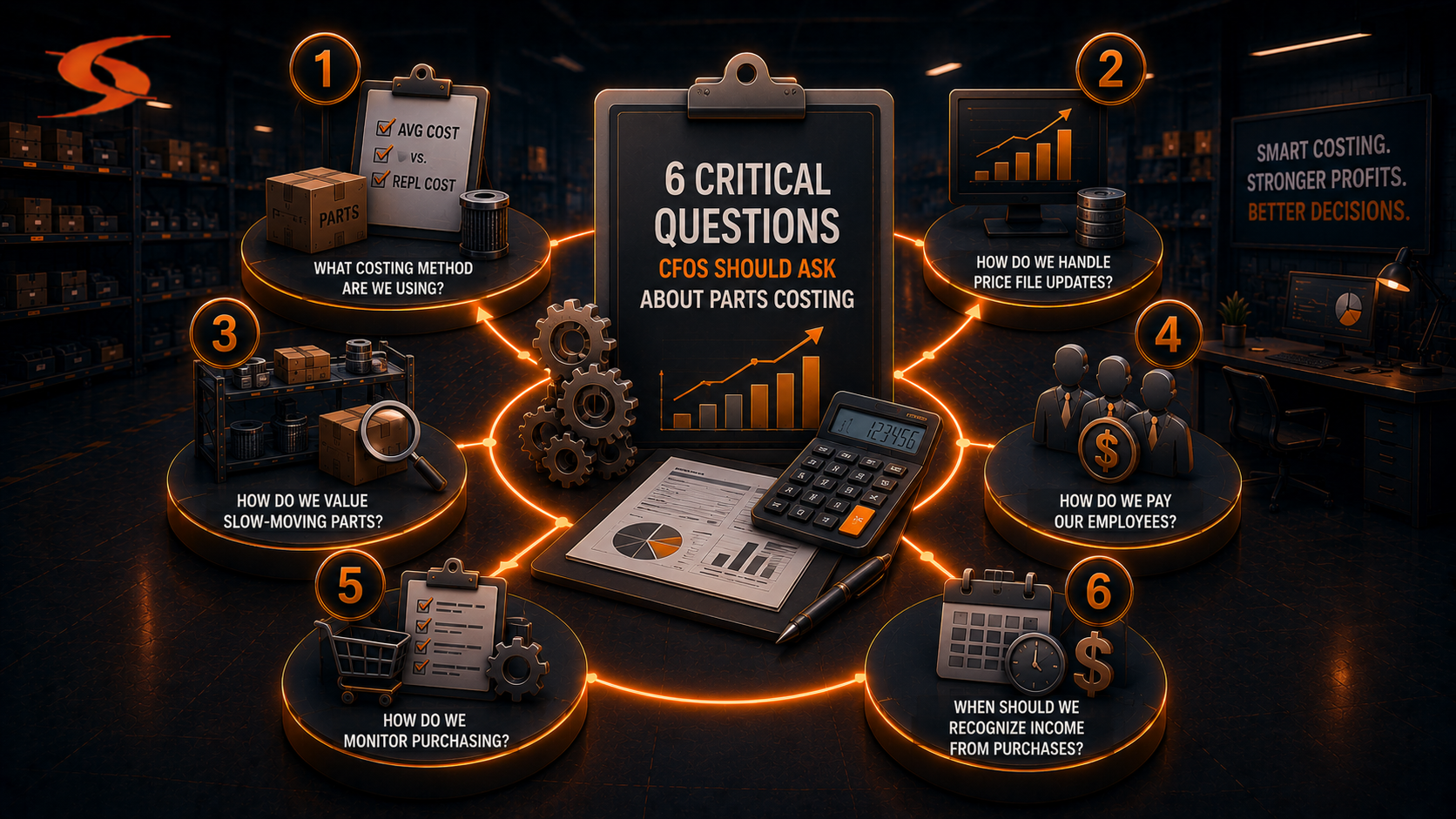
Are you confident that your parts inventory costing method is the best fit for your business? The approach you choose can impact your profitability, tax obligations, and financial strategy. In this article, we break down six key questions CFOs should ask to optimize their approach.
1. What Costing Method Are We Using?
There are two primary costing methods used in parts inventory management within the Fusion business system: Average Cost and Replacement Cost.
Average Cost Method
The Average Cost method involves valuing inventory based on a weighted average cost of all parts currently in stock. As new parts are received, they are received at their purchase cost, and the average cost is recalculated accordingly. When inventory items are committed, the inventory is relieved at the average cost of the parts on hand. This method recalculates inventory value dynamically, reflecting ongoing purchases.
Replacement Cost Method
The Replacement Cost method values inventory based on the cost per item, typically derived from a price file or price list provided by the supplier. There are parameters in Fusion that can determine when replacement cost is changed. When purchases are made at a cost that differs from the supplied cost, the variance must be recorded in an account other than parts inventory. Inventory is relieved at the replacement cost of the parts on hand when they are sold.
What’s the Difference?
The key difference between the Average Cost and Replacement Cost methods is how inventory is received and posted to the General Ledger. With Fusion’s Average Costing, the system automatically recalculates and updates inventory values upon receipt, simplifying accounting. This streamlined process allows an Accounts Payable clerk to manage entries with minimal effort.
In contrast, Replacement Costing requires an additional line item on AP invoices when costs differ from the recorded replacement cost. While this may seem minor, the administrative burden grows significantly with high invoice volumes.
2. How Do We Handle Price File Updates?
Price file updates can affect inventory valuation differently based on the costing method:
Average Cost Method
- No immediate action is required after price updates, as inventory value remains unchanged.
Replacement Cost Method
- Inventory values change when price updates occur.
- It is recommended to run a report within Fusion that quantifies the change in inventory value resulting from the updated replacement cost.
- In inflationary periods, updated Replacement Costs often increase inventory value with the offset recorded as income.
Handling Price Update Gains – Best Practices
In the heavy-duty industry, many businesses do not record gains from price updates due to software limitations in automatically calculating the impact. Instead, they rely on physical inventory adjustments, where any increase in inventory value offsets discrepancies.
While this approach may seem practical, it can mask issues like theft, damage, or poor warehouse management.
Best practice is to separately record price update gains rather than lumping them into inventory adjustments. Treating these as independent transactions ensures accurate financial reporting and prevents hidden inventory problems.
3. How Do We Value Slow-Moving Parts?
With the Replacement Cost method, slow-moving parts can become overvalued over time as price updates increase their recorded cost, even if they remain unsold. This can distort inventory reports and inflate asset values.
In contrast, the Average Cost method maintains a consistent valuation by keeping parts priced at their original purchase cost. This provides a more accurate financial picture of slow-moving or obsolete inventory.
Why It Matters
Overvaluation can distort financial reports and create misleading asset values. Using Average Cost provides a more stable and accurate picture of inventory.
4. How Do We Pay Our Employees?
Inventory valuation affects gross profit and, in turn, employee compensation structures.
If inventory is valued using the Average Cost method, it may be appropriate to base sales personnel compensation on Replacement Cost. However, executives must decide whether to link compensation to the outcomes of effective purchasing strategies.
Some purchasing decisions involve investing significant cash in inventory, such as buying more than needed to capitalize on favorable vendor deals. While beneficial, most companies are hesitant to provide raises simply because those investments were made.
Key Insight
With the Average Cost method, effective purchasing reduces costs, increasing gross profit at the time of sale. However, this can create inconsistencies in commission-based pay if compensation is tied directly to gross profit rather than a stable cost basis.
5. How Do We Monitor Purchasing?
Both Average Cost and Replacement Cost methods offer ways to assess purchasing performance.
With the Average Cost method, businesses should regularly compare average costs to replacement costs via reporting to identify pricing discrepancies and evaluate purchasing effectiveness.
The Replacement Cost method provides clearer metrics by tracking purchase discounts and premiums separately, rather than consolidating gains and losses into a single account.
Effective purchasing management should result in frequent discounts and minimal premiums. Frequent premiums may signal poor cost control or procurement inefficiencies.
Monitoring Purchasing Efficiency – Best Practice
Maintain separate accounts for discounts and premiums to ensure clear financial tracking.
6. When Should We Recognize Income from Purchases?
Effective purchasing allows businesses to acquire parts at lower costs. However, how and when discounts are recorded impacts financial reporting and tax liabilities.
By booking purchase discounts at the time of purchase, income is recognized immediately rather than at the time of sale. This can overstate inventory value and lead to premature tax payments.
Example
If $2 million in sales are made monthly with a 26% gross profit, purchase discounts of 2%, and inventory turns five times per year, the result is a $96,000 inventory overstatement. Taxes are paid upfront, effectively creating an interest-free loan to tax authorities.
Key Takeaway
Recognizing income at the time of purchase impacts cash flow and tax obligations. Timing matters.
The Verdict: Average vs. Replacement Cost
The Average Cost method is generally preferred due to several advantages:
- Simplifies processes across Parts and Accounting
- Provides accurate visibility into slow-moving and obsolete inventory
- Aligns income recognition and tax payments with actual sales performance
While the Replacement Cost method may offer benefits in certain scenarios, it requires additional accounting effort and can lead to inflated valuations.
Need help optimizing your inventory valuation? Contact your Client Success Manager, Account Executive, or email professionalservices@karmak.com
Karmak Solutions
See how Karmak helps commercial vehicle businesses streamline operations and work more efficiently.
Improve Operational ROI
Unify Sales, Service & Parts
Scale with Confidence
Related posts



Get ready to see your
business clearly.
No pressure. No commitment. Just a straightforward way to determine whether Karmak is the right fit for your operation.